|
| string | ChaiScript_Language::to_string (Object o) |
| | Converts o into a string.
|
| void | ChaiScript_Language::puts (Object o) |
| | Prints o to the terminal, without a trailing carriage return. Applies conversions to string automatically.
|
| void | ChaiScript_Language::print (Object o) |
| | Prints o to the terminal, with a trailing carriage return. Applies conversions to string automatically.
|
| class ChaiScript_Language::Function | ChaiScript_Language::max (Object a, Object b) |
| | Returns the max of a or b. Requires that operator>(a, b) exists Equivalent to.
|
| string | get_annotation () const |
| | Returns the annotation description of the function.
|
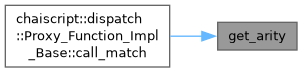
| int | get_arity () const |
| | Returns the arity of the function, -1 if the function takes a variable number of parameters.
|
| Vector | get_contained_functions () const |
| | Returns a vector of the contained functions.
|
| Function | get_guard () const |
| | Returns a function guard as function.
|
| Vector | get_param_types () const |
| | Returns a vector of Type_Info objects that represent the param types for this function. The first value in the list is the return type.
|
| bool | has_guard () const |
| | Returns true if the function has a guard to it. Always returns false for a conglomerate function.
|
| Object | call (Vector t_params) const |
| | Calls the function with the given set of parameters and returns the value;.
|
| Object | ChaiScript_Language::min (Object a, Object b) |
| | Returns the min of a or b. Requires that operator<(a, b) exists.
|
| bool | ChaiScript_Language::even (Object x) |
| | Returns true if x is an even integer.
|
| void | ChaiScript_Language::for_each (Range c, Function f) |
| | Applies the function f over each element in the Range c.
|
| Object | ChaiScript_Language::map (Range c, Function f) |
| | Applies f over each element in the Range c, joining all the results.
|
| Object | ChaiScript_Language::foldl (Range c, Function f, Object initial) |
| | Starts with the initial value and applies the function f to it and the first element of the Range c. The result is then applied to the second element, and so on until the elements are exhausted.
|
| Numeric | ChaiScript_Language::sum (Range c) |
| | Returns the sum total of the values in the Range c.
|
| Numeric | ChaiScript_Language::product (Range c) |
| | Returns the product of the value in the Range c.
|
| Object | ChaiScript_Language::take (Range c, int num) |
| | Takes num elements from the Range c, returning them.
|
| Object | ChaiScript_Language::take_while (Range c, Function f) |
| | Takes elements from the Range c that match function f, stopping at the first non-match, returning them as a new Vector.
|
| Object | ChaiScript_Language::drop (Range c, int num) |
| | Drops num elements from the Range c, returning the remainder.
|
| Object | ChaiScript_Language::drop_while (Range c, Function f) |
| | Drops elements from the Range c that match f, stopping at the first non-match, returning the remainder.
|
| Object | ChaiScript_Language::reduce (Range c, Function f) |
| | Similar to foldl, this takes the first two elements as its starting values for f. This assumes Range c has at least 2 elements.
|
| Object | ChaiScript_Language::filter (Container c, Function f) |
| | Takes elements from Container c that match function f, return them.
|
| string | ChaiScript_Language::join (Range c, string delim) |
| | Joins the elements of the Range c into a string, delimiting each with the delim string.
|
| Container | ChaiScript_Language::reverse (Container c) |
| | Returns the contents of the Container c in reversed order.
|
| Vector | ChaiScript_Language::generate_range (Object x, Object y) |
| | Generates a new Vector filled with values starting at x and ending with y.
|
| Object | ChaiScript_Language::concat (Range x, Range y) |
| | Returns a new Range with x and y concatenated.
|
| Vector | ChaiScript_Language::collate (Object x, Object y) |
| | Returns a new Vector with x and y as its values.
|
| Vector | ChaiScript_Language::zip_with (Function f, Range x, Range y) |
| | Applies f to elements of x and y, returning a new Vector with the result of each application.
|
| Vector | ChaiScript_Language::zip (Range x, Range y) |
| | Collates elements of x and y, returning a new Vector with the result.
|
| bool | ChaiScript_Language::call_exists (Function f,...) |
| | returns true if there exists a call to the Function f that takes the given parameters
|
| Range | ChaiScript_Language::retro (Range) |
| | Reverses a Range object so that the elements are accessed in reverse.
|
| Const_Range | ChaiScript_Language::retro (Const_Range) |
| | Reverses a Const_Range object so that the elements are accessed in reverse.
|
| void | ChaiScript_Language::throw (Object) |
| | Raises the given object as an exception. Any type of object can be thrown.
|